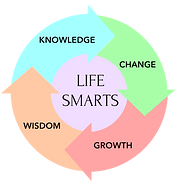
LifeSmarts Mindsets & Skillsets:
Learning for Life Beyond the Workplace
Do the Work, Own Your Impact, and Lead by Everyday Inspiring Example

NO BAND-AIDS, TIME WASTERS OR EDUTAINMENT
After spending more than a decade developing, designing and delivering both onsite and online corporate employee Learning and Development programs, I got fed up with the lack of sustainable growth and change outcomes with a majority of them. The problem isn't necessarily with the educational topics the organization chooses to provide, nor with most of the Subject Matter Experts (SME) who deliver them.
It's why they are chosen, how they are offered, and what the expected outcomes are.
OLD SCHOOL STATUS QUO WORKPLACE LEARNING & DEVELOPMENT PROGRAMS:
If you solely depend on your job to provide you with Learning and Development opportunities to facilitate sustainable growth and behavioral habit change, you may never acquire the Mindsets and Skillsets that intentionally upgrade the example you lead by and the impact you have that extends beyond the workplace
into every aspect ofyour Life.
Even if they are essentially "free" they often come with a high price:
The organization controls the why, the how, and the what you are taught.
The biggest reality obstacle for those who want the company they work for to provide them with cutting-edge growth and change transferable Mindset and Skillset tools they can use wherever they are is the fact employee Learning and Development is often solely geared towards an organization's main focus on increasing worker performance and productivity to serve their bottom line business objectives.
This is the Return On Investment (ROI) that matters to the organization, and that value is predominantly assessed by what are considered tangible metrics: attendance, course completion rates, and what predetermined hard numbers used as Key Performance Indicators (KPIs), Objectives and Key Results (OKRs) etc. are used to quantify a successful learning program.
Additionally, old status-quo leadership mindsets and cultural frameworks in place within each workplace that translate into rigid attitudes and impossible ROI expectations create more obstacles to sustainable employee learning adoption and knowledge retention. This is compounded by the lack of transparent modeling and support from all levels of titled management and leadership professionals throughout the workplace to make learning "sticky":
Perceived failures or complaints a training "didn't Work" often happens when attendees don't want to Do the Work required to make the Work actually work because they fear change and would rather cling to the known and not face their dark behavior and own their impact , even if it is causes the organization's financial bottom line to suffer - let alone experience reputational damage and lightning fast-social media blowback that can be difficult at best to correct.
Unfortunately a "profits above all else" attitude means employee personal growth Mindsets and Skillsets learning opportunities created to not only include but also extend beyond the workplace are often cut from their L&D budget, as their "provable ROI" isn't merely based upon numbers or old debunked yet persistent myths like "six weeks" or a single "weekend intensive" to attain mastery of __________ (fill in the blank - I've heard them all) is a bunch of magical thinking that blames the attendee if it didn't stick with them after that brief time frame - because it can't! BRAIN
motivational speeches give a high that doesn't last
self-help books with most filler and author has zero responsibility - let them - people don't question a best seller esp if they are from harvard but why is harvard more valuable celebrities over regulate people influencers who are self focused the secret and oprah
sunk cost bias (new age) believing something b=is wrong with you that your not havingresulst and faking it because you spent so much money
groupthink belonging (new age)
uncomfortable truths comforting lies
steinem
justifying comrpromising you integrity means leadership does not embody any of the trainings they invest in - getting away
Actual sustainable behavioral habit change that will benefit a both employee's Work + Life are pushed to a "nice to have" instead of a more urgent need to have. And when there's money in the budget to allow for some of the "nice to haves" - which are treated like "fluff" and often are "lite content" from the most recent trendy buzzwords regurgitated by self-proclaimed "experts" with little to no professional education/certification, low experience, and questionable research that may actually distort both its genuine meaning and proper application - and in some cases, even cause significant harm.
We see this everywhere, from emotional intelligence, mindfulness, DEI, and psychological safety to name just a few.
CONSIDER THIS: Since so many organizations have offered all the above topics, then why isn't each one a clear reflection of any of them? Why isn't every CEO an embodiment of them and leading by inspiring example? If there did, then employees would happily bringtb their best to their job - but instead remain stressed, under pressure, burned ou, and are
It's not the subject that's the problem.
Behavioral growth and change doesn't fit into the neat little boxes of numbers- based "proof" they work because of the fact they are lots of valuable intangibles that don't happen all at once - they show up with the Internal Operating System learning formula I've used for over twenty years:
consistent practice + repetition & continual support over time
The result is workplace L&D professionals having to accommodate the employee learning needs of an organization within the insistence they be delivered mostly online and often without whole organizational buy-in. And the larger the organization, the more unlikely collective sustainable growth and change can take place. Those are simple numbers that make it nearly impossible to facilitate L&D program adoption across the entire company.
Because attention spans have become so short, many courses indulge them by offering learning programs that are one or more of the following:
> "one and done" without the essential weeks-long follow up required for actual learning; time and money is wasted; and blame for "failure" is placed in the wrong areas
> "gamification" was created to "edutain" easily bored and distracted employees
> very little reading is assigned because people read less and are so addicted to social media they claim they just "don't have time" to read something more than a few paragraphs of text
> the fake "interaction and engagement" of chat windows that flies by so fast in webinars that few comments are responded to, and attention is drawn away from the person leading the class
> essential follow-up support to make the new learnings stick isn't given due to both financial and time costs, and attendees are often just given handouts and links to resources to explore on their own time. As if that works. Then it becomes the attendees fault if they don't ===
and possibly the worst two:
>"bandaids" are offered instead of deep investigation into addressing root causes of problems, and the sometimes difficult yet necessary solutions
>"elephants in the room" are intentionally ignored because of what I stated at the top of this page: ineffective status quo workplace systems and cultural frameworks in place that translate into rigid attitudes and impossible expectations - and the refusal for every stakeholder to Do the Work and take responsibility for the issues and problems they are causing that they expect one training to magically solve - and then place blame externally for the requested subject itself (!) "not working" (and the SME delivering it), and a learning environment and expected ROI that are simply doomed to fail.
All of this doesn't consider the COI (Costs of Inaction) if an organization doesn't provide L&D programs intentionally crafted for lasting impact and what they cost in terms of time, attention, and money and a long-term-investment ROI by ALL involved to commit to in order for the outcomes to be successful and sustainable.
Maybe they'll "raise employee awareness" with a one-off class or webinar on any broadly valuable Mindset or Skillset upgrade, but awareness without corresponding actions harm everyone in the long run, wasting precious resources while remaining stuck in the "same old same old" ways of thinking and doing.
:
ONCE AGAIN:
If you solely depend on your job to provide you with Learning and Development opportunities to facilitate sustainable growth and behavioral change, you may never acquire the Mindsets and Skillsets that intentionally upgrade the example you lead by and the impact you have that extends beyond the workplace
into every aspect ofyour Life.
Even if they are essentially "free" they often come with a high price:
THEY control the why, the how, and the what you are taught.
As an employee, you get what the organization you work for invests - or doesn't invest in all of these areas, and continuing to do the same things with the same old status quo systems and cultural frameworks expecting different results is truly insane.
HOW MUCH ARE YOU WILLING TO INVEST IN YOURSELF?