LifeSmarts Mindsets & Skillsets:
Learning for Life Beyond the Workplace
Do the Work, Own Your Impact, and Lead by Everyday Inspiring Example
MINDSETS & SKILLSETS
FOR WORK+LIFE

Mindsets refers to the sets of beliefs (and their accompanying thoughts and emotions) that shape how you navigate and make sense of the world, and your place and identity within it. They influence how you think, choose, act, communicate, and behave in any given situation, interaction, or moment, and play a key role in how you handle whatever comes your way in life.
Most people are shaped by the environments they grew up in and the attitudes, biases, beliefs, likes and dislikes, etc. they adopted within them, which may often go unquestioned as they grow older. However, this does not mean you are stuck with them - even though changing your mindsets may make people who expect you to behave the way they want you to may feel threatened. The deep human need to belong is often an obstacle when this happens, and can prompt considerable inner conflict. We all have the ability to change our mindsets and start anew, and should not be automatically held to who we once were, what we once believed, and the mistakes we've made in the past that were based upon incorrect information, unwise choices, and/or the undue influences from others.
Each of us has the power to change our Mindsets, which in turn, changes our behavior. But sustainable human learning, development, and growth must also include unlearning unproductive and harmful behavioral habits, thinking, and believing - and that doesn't happen instantaneously. However, each of us can learn how choose differently.
Skillsets are the knowledge, abilities, and experiences required to proficiently perform a job or task.
-
Hard Skills: Hard/technical/task-oriented skills are aptitudes you possess from your educational background, vocational trainings and work experience. They often refer to your ability to use particular types of tools or equipment, anywhere from computers, to hair styling, to truck driving, to surgery, to landscaping, to playing a musical instrument, to operating heavy machinery. Low Touch online learning delivery formats often work well here.
-
Soft Skills: So-called "soft skills" illustrate how you interact with others and solve non-technical problems, both personally and professionally. They are often much harder to acquire for many than hard/technical skills and require High Touch learning facilitation, consistent practice, non-judgmental feedback, and supportive reinforcement.
-
Job-specific skills: Employers may require specific abilities applicable to the position, which can be soft, hard or transferable skills. For example, if you want to work as a customer service representative, then the job-specific skills may be customer service, conflict resolution, interpersonal communication etc. Hard skills can include computer programming, vehicle mechanics, etc.

TRANSFERRABLE, INTEGRATED WORK+LIFE MINDSETS & SKILLSETS
The traditional definition of "Transferrable" Skills is generally applied to what's taught in workplace Learning and Development programs as being skills you can bring along with wherever your work/career path takes you. It's linear in both concept and design, and separates your "Work" Self and your "(Personal)Life" Self - that's why we constantly see "(fill in the blank) at Work" trainings.
During the almost two decades I mainly led classes for corporate employees (just one example: "Mindfulness at Work") I constantly asked myself "But what about when employees are NOT at work? Wouldn't it be wise to widen the scope to encompass their entire Life - and all aspects of themselves?"
I mean, duh! It only makes sense to me.
But the former is what's being sold to and bought by most large organizations. An independent Learning Facilitator (the "seller" sees this as more financially lucrative for them, and the organization (the buyer') cares mostly about offering trainees L&D education that increases employee performance and productivity to serve the business' financial goals. Even in-house L&D is focused upon an employees' "Work Self" and not as a whole person; in fact, employees are often told not to mix the two and keep their personal life separate.
Additionally, employees are given trainings in the subjects their employer wants them to learn, and may exclude those that they either don't want to and/or are being told by higher-ups not to offer and can include biases and misinformation as well as being entirely composed of content stolen with AI that may be at best incorrect and outdated.
As perhaps an unintended consequence, what we see is people having a dissociated Work and Life experience, wherein some actions and behaviors are demanded at their job that they'd never do in their personal life, setting them up for potential compromises of their integrity they justify engaging in in order to survive - and those lines often get blurred. Their Self Communication sets them up for conflicts in their internal dialogue which can adversely impact their character and destroy their moral compass - and have adverse impacts in every aspect of their Life and the example they lead by.
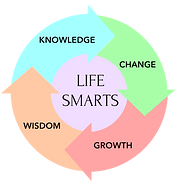
Learning for Life Beyond the Workplace integrates Work+Life Transferrable Skills with a non-linear approach that acknowledges the value of each aspect of human life informing the other in an upward spiral of Continuous, Life-Long Learning that sees and incorporates everyone as Whole Person. This requires a Whole Systems, integrated, non-linear learning framework for upgrading your thoughts, choices, actions, and behaviors – and unlearning old, worn-out, stuck, bug-ridden Mindsets and Skillsets and accompanying unproductive, self-defeating, and often harmful to ourself and others habits.
I explore root causes and not apply band-aids over symptoms. I address the elephants in the room.
Just like in health care, addressing symptoms alone can have major side effects - and doesn’t heal the core issues.
I weave together knowledge areas that are interconnected yet are often just taught piecemeal – and which only provides a partial understanding and the inability to connect the dots we can see when we zoom out and see the broad picture.


Your Mindset has a strong influence upon the effectiveness of learning and embodying the Skillsets you choose to learn compared to those you have to learn.
Your comfort levels may require being poked to become unstuck – and that’s not a bad thing.
Honest Self-Reflection is required – and humility, compassion, and a healthy sense of humor are highly recommended.
One of the biggest "A-HA moments" students express to me when they begin to be proactive
with Work+Life Mindset shifts and invest in Learning Beyond the Workplace is:
“I realized I don’t have to believe everything I think ... nor everything I'm told."